
The modern restaurant dining room is undergoing a quiet, intimate revolution. For decades, the dominant blueprint of commercial hospitality was built on scale: cavernous dining halls, sprawling floor plans, and large tables engineered to maximize party sizes and table turns. Today, a profound cultural and economic shift is redrawing the floor plan. Driven by rising real estate costs, changing urban demographics, and a growing cultural appetite for intentional, low-stress experiences, restaurants are increasingly leaning into two interconnected movements: micro-dining and bespoke solo seating formats.
Far from being a temporary novelty or a concession to isolation, this evolution represents a fundamental re-centering of hospitality. Restaurants are proving that smaller footprints and inclusive solo spaces can deliver deeper emotional connections, higher operational efficiency, and a more memorable culinary journey than the traditional dining hall ever could.
The Architecture of Intimacy: What is Micro-Dining?
At its core, micro-dining is a philosophy of subtraction. These concepts typically operate within minimal square footage—often featuring fewer than 20 to 30 seats total—and eliminate the traditional barrier between the kitchen and the guest.
From an economic perspective, micro-dining offers restaurateurs a powerful hedge against volatile commercial real estate markets and rising overhead. A smaller footprint drastically reduces front-of-house labor requirements, lowers utility costs, and tightens inventory management. Because seating is severely limited, ingredient waste plummets, and chefs can focus entirely on hyper-seasonal, high-precision sourcing. For the consumer, this operational tightness translates into an immediate sense of exclusivity and prestige: securing a reservation at a micro-restaurant feels less like booking a table and more like receiving an invitation to an exclusive culinary performance.
Solo Seating and the Solo Diner Revolution
Perhaps the most culturally significant shift accompanying the micro-dining trend is the mainstreaming—and celebration—of the solo diner. Historically, eating alone at a full-service restaurant carried an unfortunate social stigma, often relegated to an awkward corner table or a rushed meal at a hotel bar.
Modern restaurant design is actively dismantling that stigma. Forward-thinking operators are engineering dedicated solo formats that treat single diners not as an afterthought, but as VIP guests.
1. Counter Culture and Interactive Seating
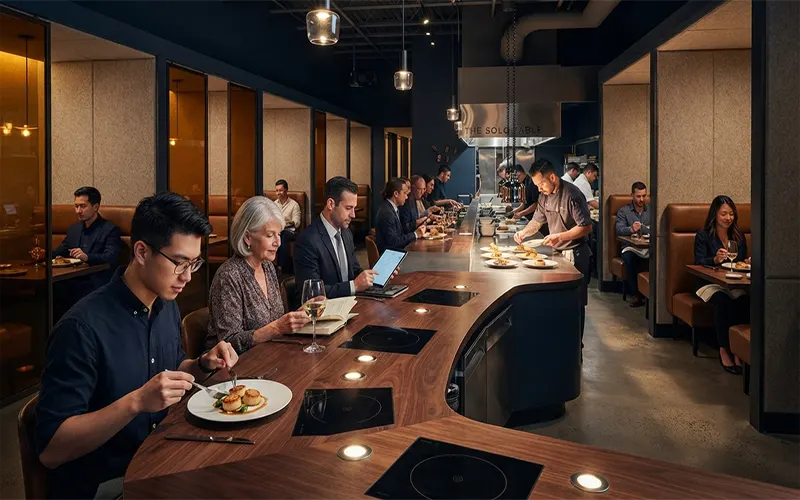
The explosive popularity of chef’s counters, open kitchen rails, and omakase-style bars has transformed solo dining from an awkward chore into a premium experience. Sitting at a counter naturally neutralizes the feeling of dining alone; guests have a front-row seat to the kitchen ballet, natural conversational access to the culinary team, and an engaging visual distraction that makes solo dining feel meditative and restorative.
2. Micro-Booths and Window Perches
Beyond the counter, restaurants are incorporating modular single-person booths, quiet corner perches, and high-top window seating designed specifically for one. These spaces offer urban professionals, remote workers, and traveling diners a sanctuary of privacy. Equipped with subtle charging ports, thoughtful lighting, and well-paced service, these spots invite guests to slow down, read, work, or simply savor their food without the social pressure of group conversation.
3. Consumer Psychology: Self-Care Through Food
This design evolution mirrors a broader societal shift. With a rising percentage of single-person households and a cultural embrace of intentional self-care, modern consumers increasingly view dining alone not as a lonely act, but as a form of luxury and autonomy. They want high-end culinary exploration on their own schedule, unburdened by the scheduling friction or compromise of large group dining.
Industry Execution and Service Adaptations
Restaurateurs are discovering that catering to micro-formats and solo diners requires a nuanced recalibration of service models:
- Pacing and Flow: Service for solo diners requires emotional intelligence. Staff must gauge whether a solo guest is looking for friendly conversation and engagement with the kitchen or a quiet, uninterrupted dining experience with a book or tablet. Pacing must be responsive—neither rushed nor neglectful.
- Modular Menus: Micro-concepts often utilize flexible tasting menus or modular small plates that allow solo diners to sample a wide cross-section of the kitchen’s capabilities without over-ordering or committing to an unwieldy multi-person sharing format.
The rise of micro-dining concepts and solo seating formats marks a permanent, customer-centric maturation of the restaurant industry. By stripping away the noise, excessive square footage, and rigid expectations of traditional dining halls, these spaces champion intimacy, efficiency, and inclusivity.
In an increasingly fast-paced world, restaurants that master the art of the micro-footprint and warmly welcome the independent diner will capture the deepest loyalty. The future of hospitality proves that when a dining experience is designed with true focus and scale-free intimacy, a table for one is the best seat in the house.