The high-stakes reality of food allergies in commercial dining leaves zero room for error. For millions of diners living with celiac disease, severe nut allergies, or dairy intolerances, eating out has historically been an exercise in high anxiety, requiring an exhausting interrogation of servers, manual cross-referencing of static paper charts, and a lingering fear of miscommunication during a chaotic Friday night dinner rush.
For commercial kitchens, managing these risks manually has long been an operational vulnerability. Today, forward-thinking restaurants are transforming food safety and guest trust by implementing advanced digital menu technology designed to deliver real-time allergen transparency across every touchpoint.
The Flaws of Static Menus in a Dynamic Kitchen
To understand why digital transformation is sweeping the restaurant industry, one must examine the fragility of legacy allergen handling. Traditionally, restaurants relied on static printed menus and static allergen matrices kept at the host stand or memorized by the front-of-house staff.
These legacy methods break down rapidly in a real-world kitchen. Supply chain disruptions mean a chef might need to swap a brand of cooking oil or a thickener mid-service. A recipe adjustment made on the fly instantly renders a printed allergen chart obsolete. Relying on human memory or frantic whispered conversations between servers and line cooks during a peak service rush creates a dangerous margin for human error—one that can lead to severe allergic reactions, medical emergencies, and devastating liability.
How Digital Menu Technology Transforms Kitchen Operations
Modern digital menu platforms—ranging from dynamic QR-code menus and table-side tablets to integrated Kitchen Display Systems (KDS)—fundamentally rewrite how kitchens manage ingredient safety.
1. Real-Time Inventory and Recipe Syncing
The cornerstone of digital menu technology is its direct integration with back-of-house inventory and recipe databases. When a culinary team updates an ingredient or changes a sauce base in the master inventory software, the change propagates instantly to all guest-facing digital menus. If a specific supplier’s soy sauce contains an unexpected wheat derivative, the item can be flagged or temporarily hidden across all digital ordering channels in a matter of seconds.
2. Granular Filtering and Guest Autonomy
Interactive digital menus empower allergic diners with total autonomy. Instead of awkwardly scanning a dense, confusing grid of symbols, guests can use intuitive digital interfaces to filter out their specific allergen triggers—whether it is gluten, dairy, tree nuts, shellfish, or soy—with a single tap. The menu dynamically updates in real time, displaying only dishes that are entirely safe for that individual, while clearly highlighting necessary modifications.
3. Seamless Back-of-House Communication
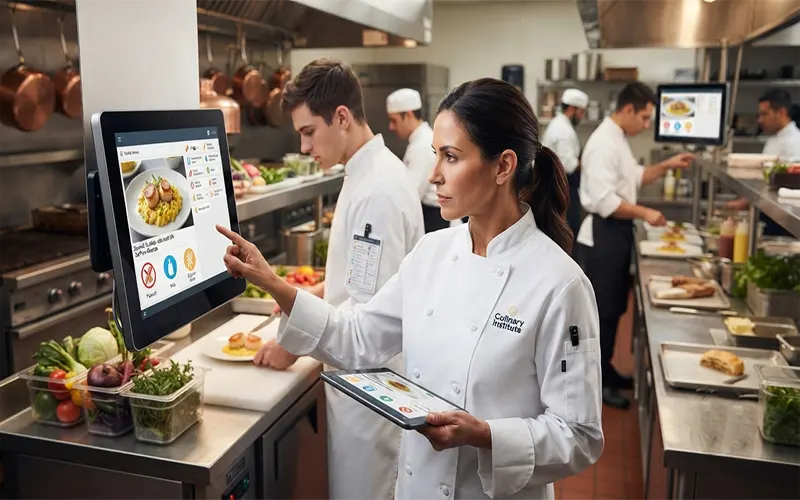
Digital transformation does not stop at the table; it extends straight into the kitchen line. When a guest customizes an order or flags an allergy through a digital ordering platform, the point-of-sale (POS) and KDS systems lock in unmissable visual alerts. The ticket prints with mandatory allergy modifiers that demand managerial or chef sign-off before the dish can be plated, completely eliminating verbal bottlenecks and miscommunication between the dining room and the line cooks.
Building Guest Trust and Compliance
Beyond operational efficiency, digital menu technology fundamentally changes the psychological dynamic between the diner and the restaurant.
When allergic guests are greeted with a transparent, data-driven digital interface that clearly explains ingredient sourcing and allergen protocols, their anxiety dissolves. They no longer feel like a burden to the kitchen; instead, they feel seen, respected, and safe.
From a business compliance standpoint, digital menus provide an immutable audit trail. In the event of a health inspection or liability inquiry, restaurants can prove exactly what allergen information was displayed to a guest at the precise minute they placed their order. This rigorous digital documentation drastically reduces risk and protects the restaurant from costly cross-contamination incidents.
The implementation of digital menu technology for real-time allergen transparency is no longer a futuristic upgrade or a trendy gimmick—it is an essential operational standard for modern hospitality safety.
Restaurants that replace outdated paper lists and error-prone manual communication with intelligent digital systems protect their guests, empower their staff, and elevate their entire operation. In the modern culinary landscape, embracing digital accountability defines the ultimate gold standard of responsible, inclusive hospitality.