
The modern real estate market is undergoing a fundamental revaluation. For decades, homebuying decisions were anchored by familiar pillars: location, square footage, school districts, and interior aesthetics. Today, a new and powerful metric has reshaped the calculus of property value: climate risk. As extreme weather events increase in frequency and severity, climate risk has officially become financial risk.
For savvy homebuyers and current property owners, the search for the ideal home has evolved. The modern gold standard is no longer just a house that looks good on moving day, but one that can withstand environmental shocks, maintain power independently during a grid failure, and shield its owner from skyrocketing insurance costs. Finding and securing a climate-resilient home equipped with solar backups and favorable insurance ratings requires a new approach to property evaluation.
The New Real Estate Calculus: Assessing Climate Resilience
What defines a climate-resilient home in the 2026 housing market? It goes far beyond standard construction. Resilient homes are engineered to actively resist localized environmental hazards, whether that means wildfire-resistant exterior materials and defensible space in fire-prone regions, reinforced roofing systems designed to withstand hurricane-force winds, or elevated foundations and advanced French drain networks in flood-risk areas.
Furthermore, buyers can no longer rely on intuition or a standard home inspection alone. Property evaluation now requires scrutinizing climate risk data tools, flood maps, and municipal hazard projections. Evaluating long-term micro-climate risks before purchasing ensures that buyers do not inherit stranded assets—properties that may face steep depreciation or uninsurability over a standard 30-year mortgage lifecycle.
Energy Independence: Solar Power and Battery Backups
Physical structural hardening protects the building envelope, but energy resilience ensures that life inside can continue uninterrupted when disaster strikes. The market has shifted decisively from passive solar panels—which shut down during a grid outage for safety reasons—to active, independent energy ecosystems.
1. The Power of Solar Plus Storage
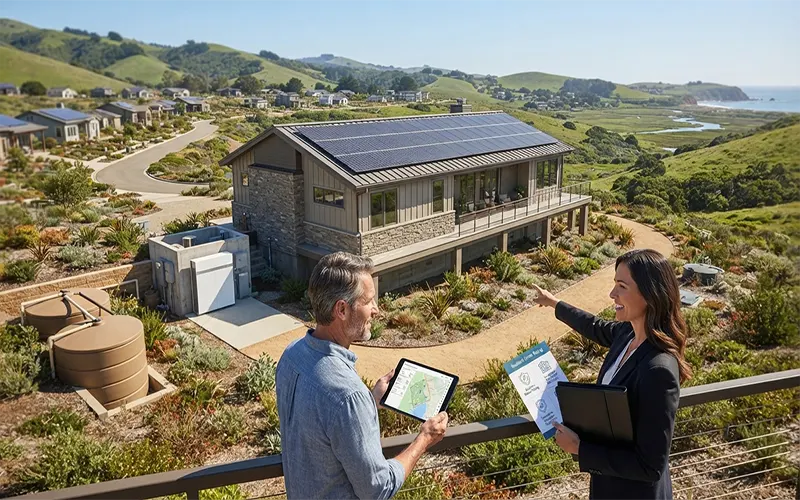
Modern resilient homes pair rooftop photovoltaic (PV) systems with modular home battery storage solutions. This combination provides a vital safety net during extreme weather blackouts, freezing winter storms, or summer heatwaves that strain local power grids. While the neighborhood goes dark, a home equipped with solar and battery storage can keep critical appliances running, maintain indoor climate control, and power communication devices.
2. Financial Shielding and Appraisal Value
Beyond emergency preparedness, integrated solar and storage systems offer immediate, ongoing financial protection. In an era of volatile energy markets and rising utility rates, on-site generation shields homeowners from escalating electricity costs. Appraisers and buyers increasingly recognize this value: homes with independent energy systems command higher resale values and sell faster than their non-resilient counterparts.
The Insurance Puzzle: Securing Lower Premium Ratings
Perhaps the most pressing financial hurdle in modern real estate is the property insurance crisis. Across many regions, homeowners face skyrocketing premiums, strict underwriting requirements, or sudden policy non-renewals as major insurance carriers pull back from hazard-prone areas.
Navigating this puzzle requires prioritizing homes that actively mitigate risk through certified building standards.
1. Mitigation Credits and Recognized Certifications
Insurance carriers reward risk reduction. Homes built or retrofitted to recognized resilience standards—such as the FORTIFIED Home™ designation for wind protection, or advanced LEED and ENERGY STAR certifications—frequently qualify for significant insurance discounts. These programs verify that a property can withstand severe impact, translating directly into lower annual premium ratings.
2. Actionable Due Diligence for Buyers
Smart buyers treat insurance feasibility as a critical contingency during the home purchase process. Before closing a deal, buyers should:
- Request a comprehensive loss history report (CLUE report) for the property.
- Verify whether the home possesses official wind-mitigation or wildfire-mitigation inspection credits.
- Obtain bindable insurance quotes early in the escrow period to ensure that the property’s resilience features translate into sustainable, manageable insurance costs.
Climate-resilient homes equipped with solar backups and favorable insurance profiles are no longer niche, eco-friendly novelties. They represent the baseline of future-proof real estate. As environmental pressures mount, properties that successfully combine structural hardening, energy independence, and financial insurability will safeguard both the physical safety of their occupants and long-term equity. In the modern housing market, investing in resilience is the ultimate investment in peace of mind.